Keynote speech at the 1st online conference on Innovative EFL Pedagogies on 3 June 2023.
I am delighted to have been invited by Dr Athina Boukhelouf to offer this keynote speech at the 1st online conference on Innovative EFL Pedagogies. Let me tell you something about myself. Throughout an educational career of over 40 years I have been fascinated by what distinguishes the great teacher from the good teacher, the novice from the expert. For over 25 years I worked as a teacher in secondary schools in the UK, six of those as a headteacher. My academic career began when I joined Bath Spa University in 2008 and began to research the relationship between improvisation and teacher expertise. In my talk today I hope to provide you with some insights into improvisation and the expert teacher along with some practical examples of the ways in which improvisation can innovate your own teaching.
A (true life) story
I have found that when I ask teachers if they think improvisation is important to them they will not only say ‘yes’ but will be able to tell me that some of their best teaching occurred when their pre-meditated plan was abandoned. So I am going to begin with an anecdote from a real teacher whose name is Roisin.
I used to plan everything, down to the last minute, and I went into a class one day and, I don’t know what it was exactly but the whole group was not in the mood for learning so I just stood up and I literally picked up my printed lesson plan and walked to the bin, dropped it in it and said “so what are we going to talk about today?” That one little thing scared the life out of me as I realised I would be winging it but I also had trust in myself … and it was a brilliant session and they actually ended up learning quite a lot because we just pulled out from what they talked about various bits that I hoped they would learn anyway. It was quite a powerful experience from my perspective and the students.
So what does this story tell us? First of all it tells us that the teacher noticed that the class were not in the mood to respond to the lesson that had been planned “I don’t know what it was exactly but the whole group was not in the mood for learning”.
The teacher then responded to what they had noticed. When she placed the prepared lesson plan in the wastepaper bin she clearly demonstrated to the class that this was going to be a different kind of lesson to the one they were expecting, she was adapting to the given circumstances and demonstrating this to the class. Asking the question “so what are we going to talk about today?” opened up a dialogue with the students.
The teacher knew she was taking a risk. “That one little thing scared the life out of me as I realised I would be winging it”. However she realised that she “also had trust in myself”, a trust that was based on her experience and expertise as a teacher. This trust enabled her to give herself permission to improvise. So, as a consequence of taking this risk “it was a brilliant session and they actually ended up learning quite a lot because we just pulled out from what they talked about various bits that I hoped they would learn anyway”. The teacher was able to make connections between what the students talked about and what she wanted them to learn anyway.
The consequence of this teacher taking the decision to improvise resulted in a brilliant lesson. It could have gone wrong but I would argue that it didn’t because of the level of expertise that the teacher had. At the time she was not aware of what she had done, her response was intuitive. But this is why it worked.
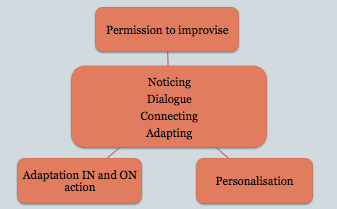
The teacher decided to give herself permission to improvise, and in doing this she adopted an improvisation mindset. Intuitively she drew upon four skills that are central to improvisational practice: these are the skills of noticing, adapting, creating dialogue and making connections.
I believe that the conscious and deliberate development of this mindset and these skills is a powerful way to develop innovative pedagogies in the classroom. This is the theme of my talk. However before I do that I need to explain what I mean when I talk about improvisation.
What do I mean when I talk about improvisation?
Improvisation is an intentional mode of creativity that takes place in real time and involves spontaneity, intuition and dialogic interaction. Improvisation is not about ‘anything goes’ as it is dependent on structures that give rise to unpredictable and unique consequences of the dynamic interplay between stability and change. I am talking about the relationship between two kinds of structure: the fixed, non-negotiable ‘design’ structures and the informal generative ‘emergent’ structures. On one hand improvisation is not special, it is present in all aspects of life: we see it in the natural world, the social world and as a form of artistic expression and performance. However, as the Roman rhetorician Quintilian points out improvisation can be artless or artful.
What I am interested in is consciously developing the mindset and the skills whereby all teachers can become artful improvisers.
Towards artful improvisation
The process of becoming an artful improviser is one that I have developed through my work in The Improvising School and written about extensively. It is a process that has two dimensions: having an improvisational mindset (by this I mean a disposition to improvise) and developing the four key skills that I outlined earlier. Let me tell you a bit more about the mindset and the four skills.
What is an improvisation mindset?
The key to becoming an artful improviser is having an understanding of what improvisation is and through this developing an improvisation mindset.
The improvisation mindset is informed by three attitudes or dispositions: permission, adaptation and personalisation. The first disposition of the improvisation mindset is concerned with giving yourself permission (and / or being given permission) to improvise and to develop an improvisational approach to teaching. This is concerned with understanding the nature of improvisation, how improvisation is dependent on structure and how it enhances and enriches learning in the classroom.
Secondly, and as a consequence giving and having permission to improvise, there is the disposition to being open to the continual adaptation of classroom practice. Adaptation takes two forms. The first is when a lesson plan is adjusted, or even abandoned, in response to a change in the direction of learning; this could be described as adaptation IN action. A second is the adaptation of an activity or lesson after it has happened, adjusting it to meet the requirements and needs of another class or taking into account some aspect of the lesson that did not work or could be improved. This could be described as adaptation ON action.
The third disposition is concerned with personalisation, through improvisation wanting to develop a personalised approach to teaching and, where possible, the environment you are teaching in. In the same way that a jazz musician aims to develop a personal sound the improvising teacher finds different ways to personalising their teaching: by getting to know the students as individuals and by the way in which the teacher presents himself or herself as an individual.
I am now going to talk about the four skills, giving examples from the research that I have undertaken.
The four key skills of improvisation:
- Noticing
- Adaptation
- Developing dialogue
- Connecting
Skill #1 – Noticing
Noticing is one of the most important skills that improvisers have. The ability to notice things is about seeing everything as an offer. Being able to notice what is happening provides greater potential for response. This is particularly true for the teacher in the classroom when they pick up and respond to the students’ ideas and suggestions.
Noticing allows us to develop our awareness of the students we are teaching and being aware of what is going on in the classroom. For example, Anne (a teacher that I observed in my research), made it quite clear from the outset that, in her opinion, the most important aspect of her expertise was the level of noticing that she gave to all of the pupils that she taught. She held great store in ‘knowing the backstory’ of each student which, in many cases, involved having knowledge of their parents and families, other siblings that she had taught or who were also at the school. This was a pool of knowledge that had been built up over a considerable period of time (Anne had taught at the school for over 10 years). By drawing on this knowledge she was able to notice and interpret the moods of her pupils. She told me ‘(I) can read them (the students) like a book. That’s what we are talking about when we talk about experienced teachers’.
Skill #2 – Adaptation
Adapting a lesson plan ‘in the moment’ is the practice that most teachers think of when they talk about improvisational teaching. The need to do this can come about for a number of reasons: responding to or building on the ideas given by pupils, reacting to time constraints, dealing with unexpected interruptions, incorporating current topical issues or news events, accepting that the class ‘just don’t get’ what you are teaching; the list is endless. The ability to be adaptable in order to engage with your pupils or to be able to clarify misunderstandings in a new way is a fundamental skill.
The ability to be able to adapt the lesson as it is happening is dependent on having a broad repertoire of responses to fall back on. Over a period of time teachers gain the experience that enables them to change their lesson plan and generate a suitable alternative. As Barbara pointed out it is about having the confidence to take risks:
With experience there is less fear that things will go wrong and that it is OK (for me) to chuck an idea out into the open and run with it … I think there needs to be an element of things coming on automatic pilot.
Barbara had the ability to take risks in her teaching because she had developed a broad repertoire of teaching strategies and a good relationship with her pupils. Experience has given her the confidence to try anything, knowing that if it doesn’t work she can fall back on other approaches and try something else. For Barbara, reflecting on her teaching helps her to adapt what she does in the classroom.
A real expert teacher is a self-reflective teacher … they put changes into planning and teaching immediately rather than wait.
Skill #3 – Developing Dialogue
Every conversation is an entry point into improvisation. A true dialogue is an open-ended experience that has no pre-determined outcome. When I say something I have to wait for a response before I can decide what to say next. Dialogue in the classroom is certainly improvisatory as it is never possible to know in advance what is going to be said. Teachers with an improvisation mindset embrace this opportunity as they know that building conversations and dialogue around learning is an important way of engaging with students and incorporating their ideas.
Improvising teachers are expert in asking questions and building conversations around learning that involve their pupils and engage with their ideas. They see teaching as a process of ‘call and response’. The ‘calls’ are the interventions made to generate dialogue and the ‘responses’ are the ways to react to what the students say. These are shown in Table 1 below.
Table 1: ‘call and response’ strategies to develop dialogic teaching
| Calls – teacher intervention strategies | Responses – teacher reaction strategies |
| Providing direction: telling Asking questions Lesson content input Giving tasks to students Managing behaviour Changing the mood | Listening Summarising Clarifying Encouraging Explaining Making links |
Skill #4 – Making connections
The classroom is a complex environment. The teacher has a lesson that they have prepared, they begin by opening up a dialogue that creates a plethora of questions. Some questions may be ‘on target’ in that they are appropriate to the content of the lesson whilst others may seem irrelevant, and some offer ideas and possibilities that had never thought of. How should the teacher respond to this situation? The improvising teacher is able to think on their feet, pick up ideas from the class and incorporate them with their lesson. They are also adept at making the lesson relevant, connecting the content to the real world and the lives of their pupils and bringing together two or more seemingly distant comments, just in the way that Roisin did.
Conclusion
I hope this presentation has encouraged you to reflect on the ways in which you, intuitively, incorporate improvisation into your teaching. I hope that you will now want to develop your improvisation mindset and, by working on the four key skills, become an artful improvising teacher. In doing so you will be able to develop innovative ways to respond to your students.
I invite you to leave comments and contribute to an on-going dialogue on artful improvisation. Share your stories of how you have become an improvising teacher and how this has benefitted you and your students.
 Nick Sorensen