Bath Spa University is proud to announce our first Professor of Improvisation, Professor Nick Sorensen. Nick, who is currently Acting Head of the School of Writing, Performance and Humanities (WPH), embodies the spirit of interdisiplinary creative inquiry which defines our institution. His groundbreaking interdisciplinary research continues to shape our understanding of improvisation across music, education, the humanities, and social practice.
Professor John Strachan, Pro Vice-Chancellor Research at Bath Spa University, said: “Nick’s appointment as Professor of Improvisation reflects Bath Spa’s deep commitment to innovation, creativity, and the breaking of new ground in research. His work exemplifies the transformative power of the arts and education in reimagining our world”.
Nick Sorensen writes:
I am very pleased to have been able to become Professor of Improvisation as this title reflects the interdisciplinary nature of my research interests that have developed over the past 40 years. My MA thesis, “The Value of Improvisation for Arts Educators” (1988) was grounded in my experience as a drama teacher and jazz musician. However, I felt that this research begged more questions that it answered, which set me thinking about the pervading presence of improvisation in social contexts.
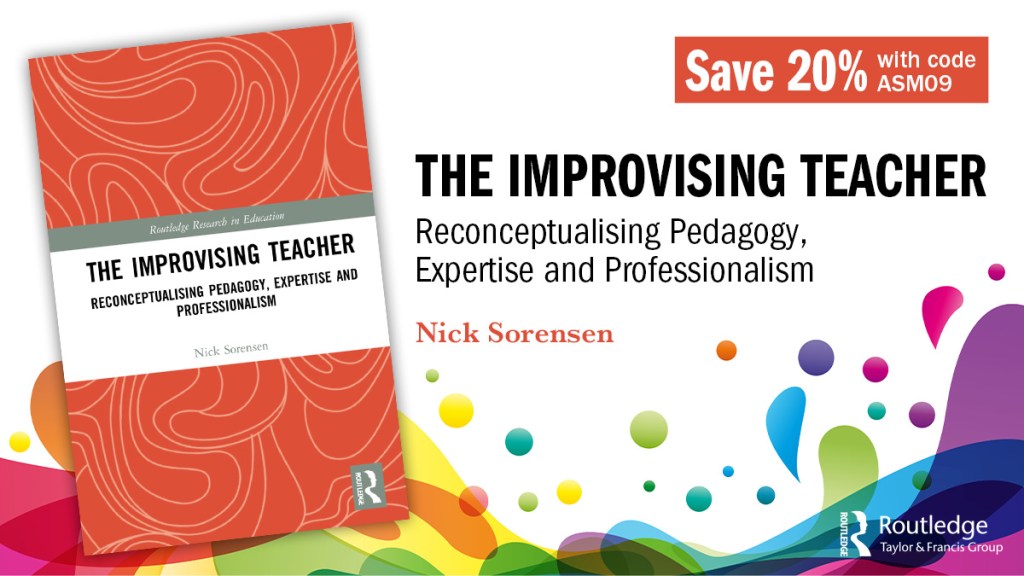
Eventually I discovered the way to explore this line of enquiry through asking questions about the relationship between improvisation and teacher expertise. This became the focus for my PhD research, a qualitative enquiry based around in-depth case studies of seven expert teachers. A monograph based on this research project The Improvising Teacher: reconceptualising pedagogy, expertise and professionalism was published by Routledge in 2023.
Becoming a Professor of Improvisation has provided me with the opportunity and motivation to continue and extend my research interests; these can be broadly divided into two areas of study. The first is centred on my practice as an improvising musician, exploring the importance of listening and silence within improvised performance, a line of enquiry stimulated by Miles Davis comment that “it’s not the notes you play, it’s the notes you don’t play that matters”. The second is concerned with the application of improvisational skills within social contexts; developing an understanding of improvisation as a mode of professional creativity in teaching, leadership and organisations.
Simon Rose, in his excellent book The Lived Experience of Improvisation: In music, learning and life sees improvisation as ‘a pervasive aspect of being human, in every sphere of life, enabling existence; life without the improvisational response is difficult to imagine’. However, improvisation has always been a problematic concept, containing a multiplicity of senses and significances that are not necessarily compatible with each other. There is a need for a better understanding of improvisatory processes and enabling the clarity of practice that is found in music and the other arts to be developed in other areas. Being Professor of Improvisation provides opportunities and to share the knowledge and understanding of what the Roman rhetorician Quintilian refers to as ‘artful improvisation’. I look forward to establishing this dialogue with others.
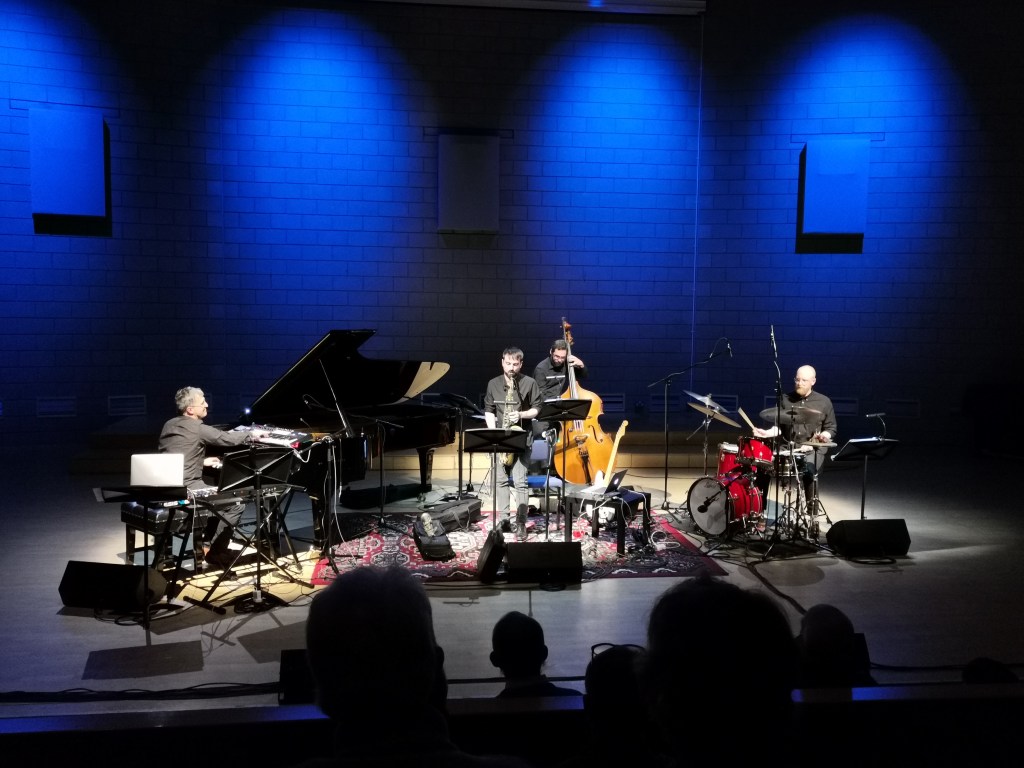
A big thanks to Stephen Morris for this lovely review of our gig at Holt Village Hall, Wiltshire on Friday 2 February 2024.
Nick Sorensen’s jazz ensemble played to a full house at Holt Village Hall in a set of virtuoso musicianship. A combination of their own compositions and nuanced interpretations of much-loved standards was rewarded by an appreciative audience of aficionados and newcomers to chamber jazz.
Gershwin’s A Foggy Day was beguiling: John Law’s piano and Paul Sandy’s bass creating a gentle tempo for Nick’s sparse, uplifting sax. For this and especially Monk’s ‘Round Midnight, the band resisted elaborate improvisation, adding some elegant, restrained touches but never straying far from the beauty of the original.
The emotion in John’s own composition The Last Dance, played as a duet with Paul, found a rapt audience needing no vocal to appreciate the yearning in the music. Benedictus – a piece for choir from Rod Paton’s Ascension Jazz Mass (look it up) – filled the hall with sound. Irving Berlin’s How Deep is the Ocean was stripped of Sinatra’s sentimentality; Stella by Starlight was lusciously bluesy.
Who expected Hendrix from a jazz three-piece? Even without Jimi’s sensational guitar Little Wing was recognisably Hendrix: sassy and loud, driven by pulse-quickening blasts from Nick’s saxophone that later had me digging around for the original recording. Hey Joe next time?
The night finished with the evocative Journey Home, the title track of Sorensen and Law’s 2010 album recorded at the Wiltshire Music Centre – a local jewel Nick was instrumental in creating and which makes our part of Wiltshire a musical hub.
Three fine musicians and an audience captivated by the music (‘a mesmerising evening’; ‘fabulous’) made for a near perfect gig – proof that our Holt Village Hall is a fine venue and one to be cherished.
Keynote speech at the 1st online conference on Innovative EFL Pedagogies on 3 June 2023.
I am delighted to have been invited by Dr Athina Boukhelouf to offer this keynote speech at the 1st online conference on Innovative EFL Pedagogies. Let me tell you something about myself. Throughout an educational career of over 40 years I have been fascinated by what distinguishes the great teacher from the good teacher, the novice from the expert. For over 25 years I worked as a teacher in secondary schools in the UK, six of those as a headteacher. My academic career began when I joined Bath Spa University in 2008 and began to research the relationship between improvisation and teacher expertise. In my talk today I hope to provide you with some insights into improvisation and the expert teacher along with some practical examples of the ways in which improvisation can innovate your own teaching.
A (true life) story
I have found that when I ask teachers if they think improvisation is important to them they will not only say ‘yes’ but will be able to tell me that some of their best teaching occurred when their pre-meditated plan was abandoned. So I am going to begin with an anecdote from a real teacher whose name is Roisin.
I used to plan everything, down to the last minute, and I went into a class one day and, I don’t know what it was exactly but the whole group was not in the mood for learning so I just stood up and I literally picked up my printed lesson plan and walked to the bin, dropped it in it and said “so what are we going to talk about today?” That one little thing scared the life out of me as I realised I would be winging it but I also had trust in myself … and it was a brilliant session and they actually ended up learning quite a lot because we just pulled out from what they talked about various bits that I hoped they would learn anyway. It was quite a powerful experience from my perspective and the students.
So what does this story tell us? First of all it tells us that the teacher noticed that the class were not in the mood to respond to the lesson that had been planned “I don’t know what it was exactly but the whole group was not in the mood for learning”.
The teacher then responded to what they had noticed. When she placed the prepared lesson plan in the wastepaper bin she clearly demonstrated to the class that this was going to be a different kind of lesson to the one they were expecting, she was adapting to the given circumstances and demonstrating this to the class. Asking the question “so what are we going to talk about today?” opened up a dialogue with the students.
The teacher knew she was taking a risk. “That one little thing scared the life out of me as I realised I would be winging it”. However she realised that she “also had trust in myself”, a trust that was based on her experience and expertise as a teacher. This trust enabled her to give herself permission to improvise. So, as a consequence of taking this risk “it was a brilliant session and they actually ended up learning quite a lot because we just pulled out from what they talked about various bits that I hoped they would learn anyway”. The teacher was able to make connections between what the students talked about and what she wanted them to learn anyway.
The consequence of this teacher taking the decision to improvise resulted in a brilliant lesson. It could have gone wrong but I would argue that it didn’t because of the level of expertise that the teacher had. At the time she was not aware of what she had done, her response was intuitive. But this is why it worked.
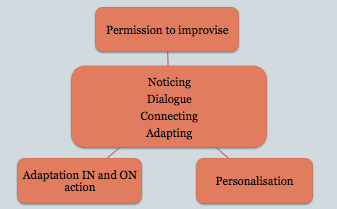
The teacher decided to give herself permission to improvise, and in doing this she adopted an improvisation mindset. Intuitively she drew upon four skills that are central to improvisational practice: these are the skills of noticing, adapting, creating dialogue and making connections.
I believe that the conscious and deliberate development of this mindset and these skills is a powerful way to develop innovative pedagogies in the classroom. This is the theme of my talk. However before I do that I need to explain what I mean when I talk about improvisation.
What do I mean when I talk about improvisation?
Improvisation is an intentional mode of creativity that takes place in real time and involves spontaneity, intuition and dialogic interaction. Improvisation is not about ‘anything goes’ as it is dependent on structures that give rise to unpredictable and unique consequences of the dynamic interplay between stability and change. I am talking about the relationship between two kinds of structure: the fixed, non-negotiable ‘design’ structures and the informal generative ‘emergent’ structures. On one hand improvisation is not special, it is present in all aspects of life: we see it in the natural world, the social world and as a form of artistic expression and performance. However, as the Roman rhetorician Quintilian points out improvisation can be artless or artful.
What I am interested in is consciously developing the mindset and the skills whereby all teachers can become artful improvisers.
Towards artful improvisation
The process of becoming an artful improviser is one that I have developed through my work in The Improvising School and written about extensively. It is a process that has two dimensions: having an improvisational mindset (by this I mean a disposition to improvise) and developing the four key skills that I outlined earlier. Let me tell you a bit more about the mindset and the four skills.
What is an improvisation mindset?
The key to becoming an artful improviser is having an understanding of what improvisation is and through this developing an improvisation mindset.
The improvisation mindset is informed by three attitudes or dispositions: permission, adaptation and personalisation. The first disposition of the improvisation mindset is concerned with giving yourself permission (and / or being given permission) to improvise and to develop an improvisational approach to teaching. This is concerned with understanding the nature of improvisation, how improvisation is dependent on structure and how it enhances and enriches learning in the classroom.
Secondly, and as a consequence giving and having permission to improvise, there is the disposition to being open to the continual adaptation of classroom practice. Adaptation takes two forms. The first is when a lesson plan is adjusted, or even abandoned, in response to a change in the direction of learning; this could be described as adaptation IN action. A second is the adaptation of an activity or lesson after it has happened, adjusting it to meet the requirements and needs of another class or taking into account some aspect of the lesson that did not work or could be improved. This could be described as adaptation ON action.
The third disposition is concerned with personalisation, through improvisation wanting to develop a personalised approach to teaching and, where possible, the environment you are teaching in. In the same way that a jazz musician aims to develop a personal sound the improvising teacher finds different ways to personalising their teaching: by getting to know the students as individuals and by the way in which the teacher presents himself or herself as an individual.
I am now going to talk about the four skills, giving examples from the research that I have undertaken.
The four key skills of improvisation:
Noticing
Adaptation
Developing dialogue
Connecting
Skill #1 – Noticing
Noticing is one of the most important skills that improvisers have. The ability to notice things is about seeing everything as an offer. Being able to notice what is happening provides greater potential for response. This is particularly true for the teacher in the classroom when they pick up and respond to the students’ ideas and suggestions.
Noticing allows us to develop our awareness of the students we are teaching and being aware of what is going on in the classroom. For example, Anne (a teacher that I observed in my research), made it quite clear from the outset that, in her opinion, the most important aspect of her expertise was the level of noticing that she gave to all of the pupils that she taught. She held great store in ‘knowing the backstory’ of each student which, in many cases, involved having knowledge of their parents and families, other siblings that she had taught or who were also at the school. This was a pool of knowledge that had been built up over a considerable period of time (Anne had taught at the school for over 10 years). By drawing on this knowledge she was able to notice and interpret the moods of her pupils. She told me ‘(I) can read them (the students) like a book. That’s what we are talking about when we talk about experienced teachers’.
Skill #2 – Adaptation
Adapting a lesson plan ‘in the moment’ is the practice that most teachers think of when they talk about improvisational teaching. The need to do this can come about for a number of reasons: responding to or building on the ideas given by pupils, reacting to time constraints, dealing with unexpected interruptions, incorporating current topical issues or news events, accepting that the class ‘just don’t get’ what you are teaching; the list is endless. The ability to be adaptable in order to engage with your pupils or to be able to clarify misunderstandings in a new way is a fundamental skill.
The ability to be able to adapt the lesson as it is happening is dependent on having a broad repertoire of responses to fall back on. Over a period of time teachers gain the experience that enables them to change their lesson plan and generate a suitable alternative. As Barbara pointed out it is about having the confidence to take risks:
With experience there is less fear that things will go wrong and that it is OK (for me) to chuck an idea out into the open and run with it … I think there needs to be an element of things coming on automatic pilot.
Barbara had the ability to take risks in her teaching because she had developed a broad repertoire of teaching strategies and a good relationship with her pupils. Experience has given her the confidence to try anything, knowing that if it doesn’t work she can fall back on other approaches and try something else. For Barbara, reflecting on her teaching helps her to adapt what she does in the classroom.
A real expert teacher is a self-reflective teacher … they put changes into planning and teaching immediately rather than wait.
Skill #3 – Developing Dialogue
Every conversation is an entry point into improvisation. A true dialogue is an open-ended experience that has no pre-determined outcome. When I say something I have to wait for a response before I can decide what to say next. Dialogue in the classroom is certainly improvisatory as it is never possible to know in advance what is going to be said. Teachers with an improvisation mindset embrace this opportunity as they know that building conversations and dialogue around learning is an important way of engaging with students and incorporating their ideas.
Improvising teachers are expert in asking questions and building conversations around learning that involve their pupils and engage with their ideas. They see teaching as a process of ‘call and response’. The ‘calls’ are the interventions made to generate dialogue and the ‘responses’ are the ways to react to what the students say. These are shown in Table 1 below.
Table 1: ‘call and response’ strategies to develop dialogic teaching
Calls –teacher intervention strategies
Responses –teacher reaction strategies
Providing direction: telling Asking questions Lesson content input Giving tasks to students Managing behaviour Changing the mood
Listening Summarising Clarifying Encouraging Explaining Making links
Skill #4 – Making connections
The classroom is a complex environment. The teacher has a lesson that they have prepared, they begin by opening up a dialogue that creates a plethora of questions. Some questions may be ‘on target’ in that they are appropriate to the content of the lesson whilst others may seem irrelevant, and some offer ideas and possibilities that had never thought of. How should the teacher respond to this situation? The improvising teacher is able to think on their feet, pick up ideas from the class and incorporate them with their lesson. They are also adept at making the lesson relevant, connecting the content to the real world and the lives of their pupils and bringing together two or more seemingly distant comments, just in the way that Roisin did.
Conclusion
I hope this presentation has encouraged you to reflect on the ways in which you, intuitively, incorporate improvisation into your teaching. I hope that you will now want to develop your improvisation mindset and, by working on the four key skills, become an artful improvising teacher. In doing so you will be able to develop innovative ways to respond to your students.
I invite you to leave comments and contribute to an on-going dialogue on artful improvisation. Share your stories of how you have become an improvising teacher and how this has benefitted you and your students.
Since 2003 my consultancy company The Improvising School has been providing opportunities for musicians, writers, educators and others to become artful improvisers by learning the skills that are at the heart of all creative interactions. This work is summed up in the adage “learn to improvise: improvise to learn”. I am however always interested in discovering and supporting others that share the same aims as The Improvising School. Two such people are Lise Huber, who runs the Bristol, UK based company Sound Your Voice and Danielle Styles of Bird Flies Free: vocal improvisation coaching. Their partnership began two years ago when they developed a vocal improvisation course that they called Free Your Voice!
The participants of the course they ran in Spring 2022 gave such positive and encouraging feedback that they have been inspired to develop the course further.
This year they are running two levels of Free Your Voice! over two weekends.
Level 1 | 20-21 May | Gibson Road, Cotham, Bristol
Level 2 | 3-4 June | Beacon Music Centre, Southmead, Bristol
The aim of Free Your Voice! Level 1 is ‘to unlock your creative voice and overcome your nerves’.
This course is for singers who’d love to feel comfortable improvising in front of other people, but their nerves start to kick in at the very thought of taking the risk to sing out. Level 1 offers a gentle, supported journey into the magic of Collaborative Vocal Improvisation over a weekend. Through participating in improv exercises and learning simple yet powerful body–mind tools, singers will start to step outside their comfort zone and gain confidence to share their creative voice.
The aim of Free Your Voice! Level 2 is ‘to help singers improvise solo with freedom and confidence’.
This course is for singers who already have gained experience of improvising, being creative with their voice and can sing in front of others without being completely overwhelmed by nerves. Singers will learn how to practise and prepare for improvised solos, so they can really own them!
This weekend course provides a rare opportunity to focus on improvising solos, within the context of Collaborative Vocal Improvisation. There will be a chance to practise being heard soloing within a safe and supportive group. Lise and Danielle will use embodiment tools, combined with a gentle, playful approach, to loosen your inhibitions and pave the way for you to ‘take the stage’ and enjoy your moment to shine!
If you are a singer and feel that these courses provide the opportunities that you have been looking for then I would encourage you to contact Lise and Danielle. These two experienced workshop leaders are looking forward to meeting up with singers, improvising with them and helping them to discovering their unique voice.
Johan ‘t Hart is an educator based in Amsterdam, the Netherlands.
What can we learn from expert teachers? This is the question Nick Sorensen puts forward in his book The Improvising Teacher. With the aid of head teachers of secondary schools in England Nick Sorensen selected a number of expert teachers. He observed the way they taught and found similarities: all of these expert teachers were great communicators, they worked efficiently and used the time of their students well. The most important finding of the book is that in every lesson these expert teachers adapted the way they worked to make it suitable for each particular group of students. For this to happen they improvise on their lesson plan.
The observations described in this book lead to recommendations. Nick Sorensen suggests that developing the ability to improvise should be included in teacher education programmes. To make this happen Nick Sorensen is currently collaborating with a Dutch initiative vriendelijkordehouden.nl that proposes similar goals.
About Johan ’t Hart Johan is an educator and music teacher with 37 years of teaching in a secondary school: The Pieter Nieuwland College in Amsterdam. After 20 years of teaching, a former student, the rapper Tony Scott, asked if he could co-operate with Johan. For 15 years Johan and Tony worked together and started the foundation: rapucation.eu With this foundation they organized projects based on story-telling and rap. Later Johan started coaching teachers with vriendelijkordehouden.nl. Currently Johan and Nick are co-operating in translating this website into translated into friendlyandfairteaching.com. Johan also plays in a band: conductorsband.com. Their latest album Conductors Band Classic Blues can be heard on Spotify.
I am delighted to receive another response to my book “The Improvising Teacher” from Mark Wilson.
Mark Wilson is at heart an educator. He has worked as a drama teacher and a qualified professional coach with over thirteen years’ experience of working in HE institutions. He is very much a renaissance man: he is also a writer, theatre director and visual artist. He says “whatever we use to create, be it film, dance, oil paint, music – anything, I believe that what we are doing, at heart, is story-telling”
In ‘The Improvising Teacher’, Nick Sorensen makes the case for the view that the very best teaching – and, indeed, the most natural form of learning – involves a flexibility, a pragmatism and a way of ‘seeing’ the discovery potential within a context that we might call improvisation.
Bringing a focus to learner curiosity as an essential element to children’s learning, the writer describes how, at their best – and both consciously and unconsciously – teachers develop an improvisational skills base with which to respond to that most powerful of learner responses.
Supported by both theory and empirical case-study evidence, he now calls for a radical shift in the way we view and enact expertise within the teaching space, arguing that an improvisational approach, rather than being an unquantifiable and thus inherently messy – even dangerous – teaching style, actually harnesses the very oldest of learning traditions: ‘trying stuff out’. It is this, he argues, that now needs to be developed to form a key element within teacher training programmes as a way of restoring a freshness and dynamism to children’s learning.
If you would like to offer a response to my book please leave a comment below. I’d be delighted to know what you think of improvisation as a form of expert teaching and how this informs your creative practice – whatever you do.
Cliff Jones, director of Critical Professional Learning, http://www.criticalprofessionallearning.co.uk/ has written a stimulating repsonse to my book. Cliff has given his permission for me to share his review here; it has also been published in Post 16 Educator issue 109. http://post16educator.org.uk/
It is always gratifying when a book stimulates dialogue. Thank you Cliff for getting the ball rolling. Do get in touch if you like to make a contribution.
‘The Improvising Teacher: Reconceptualising Pedagogy, Expertise and Professionalism’ by Nick Sorensen
Book review by Cliff Jones
Reading this so useful, interesting and stimulating book I found myself making use of my personal professional prism. A professional life spent trying to make sense of far too much policy-making by non-professionals, particularly politicians, leaves me with a store of anecdotes. Nick Sorensen acknowledges the importance of professional anecdotes and while he is analysing, classifying and showing the significance of such stories as they relate to each other and to a body of theory I had to resist wallowing in my own. Allow me to share a few and, perhaps, reveal some personal philosophy.
Let me start with a Michael Barber story. It was he who not only created the educational policy of New Labour but deeply influenced its approach to government in general. Known as Mr. Deliverology, his presentations were also caricatured by civil servants as ‘Death by flow chart and bullet point’. He refers to teachers as ‘instructors’, as though their job is to tell young people what they must know, understand and be able to do. Discovering penicillin by accident would get no marks.
One day I was about to tell the Director of the Training and Development Agency for schools (TDA) what I thought of Barber when he jumped in with, “He is my hero.” I shut up. How, I wonder, do you place improvisation on a flow chart if you believe that it is the job of professional educators to instruct students so that they have only the knowledge, understanding and skills required by an approved curriculum and examination system? Maybe you can but it would not come naturally to me.
As a public examiner I learned so much from those responding to questions I had set. We called them ‘stimulus questions’. It was the task of examiners to make sense of what was presented to them, not simply to count the ticks for ‘correct’ answers. Both teachers and examiners become learners when they respond to the improvisations of those that are officially designated as learners. And doing that in the classroom can be wonderful. My personal professional regret? I ought to have said more to them about what I was learning from those I taught.
This book of Nick Sorensen’s goes deeply into the business of improvisation in teaching. At times we may all have had to wing it when, for example, shoved in front of a class you do not know with no time to prepare, but even then experience provides a professional hinterland to be called upon.
The book looks at Pedagogy, Expertise and Professionalism. I once asked a group of professional educators to tell me what word the first seven letters of ‘professional’ gave us. That was me improvising as I only had seconds to prepare what I had to say. I was, however, drawing upon a long-term interest in questions such as that.
Finding words to describe what a professional educator believes in is subject these days to official pressure. When Nick Gibb was Minister for Education he not only tried to interfere in the Advanced-Level Politics syllabus by removing feminism as an item but also told teachers that to allow criticism of capitalism in the classroom was extremist. Gibb was defeated in his attack on feminism, but it required a campaign to stop him. To narrow both the scope of the curriculum and the focus of the examination system is to constrain the improvising teacher.
In 1991 John Major made clear his opposition to question papers in the General Certificate for Secondary Education (GCSE) that allowed for differentiation by outcome, bringing about the tiering of papers, and also discouraging coursework. That, I believe, constrained improvisation by students.
I remember Kathleen Tattersall, when head of what was then the Northern Examiners Association (NEA) announcing to an assembly of Chief Examiners, gleefully I thought, that because the new GCSE in English was all course work girls had out performed boys. The general belief was that girls liked to get involved in the research that course work demanded.
As a jazz saxophone player Nick tells us that empty professional heads are no good at improvising. I am reminded of the story of someone asking directions, only to be told, “If I were you I wouldn’t start from here.” The improvising teacher always starts from somewhere. So do improvising saxophone players.
The book reminds us of a number of governmental educational initiatives. Let me mention two contrasting ones. Postgraduate Professional Development (PPD) was a scheme that funded masters and doctorates for schoolteachers in England. It was devised, developed and annually evaluated collaboratively between a government agency and members of the profession. Up to thirty five thousand teachers annually registered to take part. They were writing about their professional interests, concerns and anxieties. They were critically reflecting on their jobs and also upon the impact of many governmental educational policies. They wrote a lot of words. The scheme was ended by government. My view is that government had no intention to open their ears to professional voices.
By contrast the Masters in Teaching and Learning (MTL) was introduced as an official initiative. Despite professional attempts to develop it on a collaborative basis its legitimacy was not inclusive. It no longer exists.
Many of the examples provided in the book are specific to England but, I believe, relevant for professional educators all over the World. The struggle between official control and constraint and professional creativity is not confined to one country. Nurit Peled-Elhanan’s book PALESTINE in Israeli School Books, Ideology and Propaganda in Education (2013) reveals how the forces that constrain and control can often be so effective that they become internalised and hardly noticed. The book of her academic colleague, Samira Alayan, Education in East Jerusalem: Occupation, Political Power, and Struggle (2018) reveals more obvious control and constraint and also a professional weakness demonstrating that power is not in the hands of the teachers.
Today in England, however, government is making a concerted effort to impose its own notions of how teachers not only qualify but also work as teachers. Universities with considerable experience of preparing and working with schoolteachers are under threat.
Nick Sorensen does not torture us with flow charts. He does, however, provide us with very accessible figures that help us make sense of the theme of the book.
Let me say what this book is not. It is not an instruction manual in how to improvise. It recognises the constructive complexities of improvisation and encourages teachers to become professionally enriched by the process. He takes us through so many attempts to define what it is to be a professional educator. One of my favourites was Expert Teacher, known usually as E.T. Imagine the fun that was had by professionals because the term Extra-Terrestrial could not be avoided when people worked out what it might mean. Nevertheless, there is much to be gained by re-examining those attempts to explore and articulate the varying and developing roles of the schoolteacher.
Sorensen brings to the term Expert Teacher and to others such as Advanced Skills Teacher more than a reminder of the thinking of the time when they were introduced. He adds important description and analysis that is useful today in more than one country. Having read his book I would love to sit down with Nick to discuss the belief of Lawrence Stenhouse that teachers are, or should be seen as, researchers. Stenhouse even proposed that Her Majesty’s Inspectors (HMI) ought to be collaborators with schoolteachers in that research. Imagine that: the people who inspect you are also your partners in exploring what it is to be a professional educator. Gosh!
What I have written above is more of a response than a review. There is so much in this book that does far more than inform. I found it stimulating. It is both authoritative and supportive. It is also comprehensive. Not many books will give you jazz and Greek philosophy. It is not a passive book. Readers will bring much of themselves to the book.
At last! My book ‘The Improvising Teacher: Reconceptualising Pedagogy, Expertise and Professionalism’ has been published by Routledge. As any author will confess it is an exciting moment when you are able to hold your book in your hand and witness the culmination of a long journey.
As a way of introducing the book I thought I would share some reflections on why I wrote the book, outlining the personal interests that motivated me to see this project through to its completion.
I have always been aware that one of the characteristics of great teachers is that they have the ability to improvise. In fact most teachers when asked if they think that improvisation is important to their practice will not only say ‘yes’ but will then be able to supply a story about how some of their best teaching occurred when the premeditated lesson plan was abandoned.
Furthermore, when a teacher chooses to improvise, or is forced to do so, it can lead to some of their best experiences as an educator. They come alive as they step ‘into the moment’, respond to the unexpected and gain confidence in their ability to engage with and relate to students. Out of necessity they draw upon their full range of professional experiences and who they are as a person. I consider that teacher improvisations provide a portal into the nature of teacher expertise. However not every teacher has the confidence to talk about the way they improvise and to share that skill with others. Why might this be? I think it is because they don’t have the concepts or the vocabulary to celebrate one of their key skills.
My curiosity about this motivated me to undertake a research project to study the improvisatory nature of expert teaching. Three personal interests drove this research. The first of these is my long-standing interest in improvisation as a musician (I am a jazz saxophonist) and as researcher. My academic interest in improvisation began in the mid 1980s when I enrolled for the Independent Studies MA in Education at the University of Sussex. This provided me with an opportunity to explore improvisation as a significant and identifiable mode of creativity that could be found in all the Arts, not just in music (Sorensen, 1988)
Having gained my Masters I was very aware that there was so much more to be said about improvisation, particularly in the context of ‘everyday life’. In our social lives we improvise continually: whenever we engage in a conversation, try to do something we haven’t done before or ‘make do’ with the resources that we have available. If improvisation is all around us surely it must be happening in the classroom?
The second area of interest, which is derived from the first, came from my professional role supporting the continuing professional development of teachers, initially as an independent education consultant and then as a senior lecturer in higher education (HE) leading a professional masters programme (PMP). I started asking questions about what great teaching looked like.
Thirdly, the debates that arose out of the educational reforms initiated by the UK coalition government from 2010 to 2015 gave rise to a number of questions about what great teaching looked like. What was meant when politicians talked about ‘effective practice’? I felt it was important to develop a grassroots, ‘bottom up’ perspective of advanced professional practice as opposed to the ‘top down’ policy led approaches outlined in documents such as ‘The Importance of Teaching’ (DfE, 2010).
Writing this book has provided me with the opportunity to give a full account of a research project undertaken to explore the relationship between improvisation and expertise for teachers. Additionally it has allowed me to re-engage with ideas that had been developed both prior to and also subsequent to the research. In contemplating the overall design for this book I realised that it would be logical to bring all of these ideas and concepts together in order to be able to explore and articulate the relationship between them.
Early work on the authorised teacher (Sorensen and Coombs, 2010a) and a long-term framework for teacher development (Sorensen and Coombs, 2010b) seemed to complement the arguments for the improvising teacher. More recent writings have explored the implications of the research findings within specific contexts: the craft of teaching musical improvisation improvisationally (Sorensen, 2021a), the importance of the applied improvisation mindset (Sorensen, 2021b) and the development of expertise in Higher Education teaching (Sorensen, 2022).
By bringing these ideas and concepts together in one volume offers a synoptic account of the work that I have done over the past 40 years considering the meaning and value of improvisation and its importance for teachers. The process of writing this book brought about a realisation of how my thoughts have developed over this time and this has resulted in the development of some ideas and the revision of others.
I hope that this book will provide a greater understanding of the creative agency of teachers and the positive impact that this has upon students. Furthermore I hope that it encourages a collective effort by teachers, school leaders and policy makers to create cultures that are conducive to improvisation and the shared development of expertise. Do get in touch if you would like to know more or if you would like to share you stories of teacher improvisation.
References
Department for Education. (2010) The Importance of Teaching, London: The Stationary Office.
Sorensen, N (1988) The Value of Improvisation in Arts Education. MA thesis. Brighton: University of Sussex.
Sorensen, N. (2021a) ‘The craft of teaching musical improvisation improvisationally: towards a theoretical framework’. Chapter 16 in The Crafts of Music Education: Reframing Practices and Theory. Springer Press.
Sorensen, N. (2021b) ‘Of course we improvise!’ What the best teachers do (and why they do it). Chapter in The Applied Improvisation Mindset. London: Methuen Drama.
Sorensen, N. (2022) ‘Developing the improvising teacher: implications for professionalism and the practice of expertise in improvisation’ in Developing Expertise for Teaching in Higher Education: practical ideas for supporting educational development London: Routledge.
Sorensen, N. and Coombs, S. (2010a) ‘Whither Postgraduate Professional Development? Towards a theoretical framework to guide long-term teacher development in England’, Professional Development in Education, 35 (4): 683-689.
Sorensen, N. and Coombs, S. (2010b) ‘Authorized to teach?’, CPD Update, 126 (May 2010): 8-9.
In 2015 I attended a conference in Stord, Norway, that addressed the theme of ‘The Art and Science of Improvisation in Education’. What amazed and impressed me was the serious attention being given to improvisation as a vital and necessary aspect of education in Norway. It is noticable that such attention is not afforded to this topic in the UK. At this conference I had the privilege to meet Magne Espeland, a Professor of Music and Education at the Western Norway University of the Applied Sciences. I presented a paper on the relationship between improvisation and teacher expertise and this led to being invited to contribute a chapter to Music Education as Craft: Reframing Theories and Practices. This book is a Festschrift for Magne in honour of his career as a music educator, researcher and national and international influencer in music education.
This book brings together leading international authors in the field of music education who take the concept of ‘craft’ as a starting point to deconstruct and reconstruct their understanding of the practices and theories of music education. You can find out more about this book here:
My contribution offers a theoretical framework (shown below) to inform the craft of teaching musical improvisation improvisationally. I see this as a hybrid craft that draws on the craft of musical improvisation (what is being taught) and the craft of improvisational (expert) teaching (how to go about teaching musical improvisation). What follows is a brief outline of the framework that hopefully will engage your curiosity to seek out the full chapter.
The craft of musical improvisation (what we are trying to teach) comprises four dimensions:
The contextual. This is the source material, tradition or idiom that informs the basis of the improvisation and includes the musical techniques, resources and vocabulary with which to improvise.
The dialogic. Musical improvisation is a relational activity and requires the ability to engage in a dialogue with other musicians and the audience. Improvisers need to develop the ability to listen and respond in the moment.
The affective. The essence of improvised music is feeling, of being able to go beyond the notes and engage with the affective dimension of a musical situation. This is principally gained through the experience of engaging in improvisation both as a participant and as part of an audience.
The cultural. The concept of culture is about “the way we do things around here” and this dimension is concerned with the permissions that we give ourselves, and are given, to improvise. The cultural dimension acknowledges the democratic and egalitarian nature of improvised music making, making sure that all participants are heard and valued equally.
The craft of teaching Improvisationally is characterised by four processes (the how of teaching musical improvisation):
Utilising tacit knowledge. Teaching improvisationally demands that you are able to make decisions and professional judgements in the moment. These decisions are not random but a grounded in experience, they have become ‘unconscious competences’. Teachers with this tacit knowledge are able to draw upon a broad range of responses to situations in order to provide what may seem like automatic responses in what they do.
Employing a dialogic pedagogy. Teaching improvisationally involves seeing teaching and learning as a relational and interactive process, the characteristics of dialogic teaching. Dialogic teaching is by definition improvisatory, as you can never predict which ways a conversation will go. Being adept at teaching in this way means being able to take a range of different, and sometimes unexpected, contributions from students and relate them to the lessons main learning objective. Eliciting ideas in this way allows students to inform the direction of learning and is a way of engaging and empowering them in the learning as co-constructors of knowledge.
Personalisation (of learning, the teacher and the learning environment). An important aspect of teaching is having the confidence to engage with students on a personal and human level. Expert teachers are adept at doing this and the personalisation of teaching is particularly significant when teaching musical improvisation, as one of the major milestones for the improviser is to develop a personal sound and an approach to improvising that is identifiably theirs.
Continual adaptation through self-reflection. One of the key aspects of teaching improvisationally is being able to make ‘in the moment’ adaptations of the lesson plan. As Schon (1983) point out ihis can happen in two ways: reflection in action (imediatley responding and apdating the lesson) or reflection on action (critically reflecting and reviewing teaching after the event).
The theoretical framework for teaching musical improvisation improvisationally is created by bringing together the four dimensions of teaching improvisation (the what) and the four processes of improvisational teaching (the how). This framework emphasises the congruencies between what we teach how we teach it.
Given the elusive, fleeting and embodied nature of improvisation as a phenomenon it is not possible to ‘tell’ someone how to improvise but it is possible to create learning experiences that enable individuals to engage with the affective aspects of improvisation and through reflection (both in and on action) to articulate their own identity as an improvising musician.
I am fascinated by the relationship between improvisation and learning. The best way to learn how to improvise is to improvise. By improvising we also learn about how we can learn to improvise. Simon Rose (2019) talks about the “modes of creative, collaborative, embodied learning that improvisation presents”; Guy Claxton (1999) considers learning to be something to do with “what you do when you don’t know what to do”, a mandate for improvisation if ever there was one.
The craft of teaching musical improvisation improvisationally draws upon the two domains of musical improvisation and pedagogic improvisation. The transfer of knowledge between these two areas creates a metacognitive dialogue that I hope will be a fruitful starting point for those that wish to develop their craft as music educators.
References
Claxton, G. 1999. Wise Up: the challenge of lifelong learning. London: Bloomsbury.
Rose, S. 2017. The Lived Experience of Improvisation: in music, learning and life. Bristol: Intellect.
Saturday 23rd October 2021: The Wiltshire Music Centre, Bradford on Avon.
We had to wait (and it was a long wait) but it was worth it in the end. There was a palpable sense of relief and joy, from band and audience alike, when John Law’s Congregation took to the stage at the Wiltshire Music Centre to present music from their critically acclaimed album CONFIGURATION. Released in May 2020, and garnering more than its fair share of critical accolades by the end of the year, the pandemic curtailed the opportunity to promote this first release for the Ubuntu record label. The question was – how will this music come over in performance after all this time?
The answer is that is that it did so magnificently. John Law’s Congregation offer contemporary jazz that is intelligently informed by a wide range of influences: free jazz, progressive rock, fusion, electronics, minimalism and classical music. Each half of the concert began with a new composition. The first half got under way with ‘Passion’, a tune ushered in with a sample taken from Bach’s St John Passion whilst the second half commenced with the mischievously titled ‘Do You Do Voodoo (I Do Voodoo Too)’.
The bulk of the programme comprised compositions from the CONFIGURATION CD. Each of these pieces conveys a distinctive sound world and the musicians John Law has assembled are perfectly matched to realise these intentions and, as Thelonious Monk put it, “to lift the bandstand”. The interplay between Dave Hamblett’s sensitive and precise drumming, Ashley John Long liquid bass lines and and James Mainwaring’s mercurial saxophone was especially prominent in ‘Complex City’, a tune inspired by the bands visit to India. Other highlights included John Law’s transcendent four-minute introduction to ‘Configuration’, James Mainwaring’s ethereal guitar on ‘And Them’ and the well-deserved encore, the appropriately titled ‘Method In My Madness’.
Overall this was a joyful and memorable evening that ran the musical gamut. From complex composition to inspired improvisation, from the knotty theme of ‘Method In My Madness’ to the melancholic lyricism of ‘Scandinavian Lullaby’. The range of moods and sounds was captivating and inspiring. The ‘official’ London launch of CONFIGURATION takes place on Wednesday 27th October at Kings Place, 90 York Way, London, N1 9AG. If you can get there do not hesitate to get a ticket … if not look out for further dates on this tour. This is a band that is not to be missed.

 Nick Sorensen